Geassa
Esoteric

Promoting the research, study & practice of the Esoteric Arts
“Dame, Dame, the watch is set.
Quickly come, we are all met.
From the lakes, from the fens,
From the rocks, and from the dens,
From the woods, and from the caves …
Here are we.”

Goddess Diana
The Lady in many Witchcraft Traditions
These are lines from the first “Charme” in the play “The Masque of Queens” written in 1609 specifically for King James, the same personage who had commissioned the translation of the Bible into the English version now most referenced today. In “The Masque of Queens” a major scene clearly depicts a meeting of Witches gathered for ritual. The play was written at a time when King James had begun one of the most aggressive persecutions of Witchcraft in history. The play’s author, Ben Jonson, was a contemporary of William Shakespear[1] who, himself had written of Witchcraft. During this same general period Reginald Scot’s now famous “A Discoverie of Witches” first appeared. This was an era when operative, historical Witchcraft was very much alive.
What is intriguing to me is that given the impact of Christianity at the time, one would expect Jonson’s play to center on the Witches’ interaction with “the Devil”. Yet the Devil is nowhere to be seen. Rather, it is the evocation of a mysterious lady, the “Dame”, that figures so prominently. In this short article I am not going to dive into the various historical references that lend support to the importance of female otherworld beings in operative, historical Witchcraft, though there are many. Rather, I would like to address the question of who this Lady is, and what role she plays in Old Craft. Keep in mind that I use the term “Old Craft” primarily to distinguish operative, historical Witchcraft from the more modern forms that have fallen under the umbrella of “Wicca”. Also know that at no time am I implying that there was a centralized ‘religion’ or large scale pagan organization in existence in pre-industrial era Europe that equates to Witchcraft. However, the fact that practical, operative sorcery existed among the ‘common’ people can’t be disputed. Given the social nature of human beings, it would seem to be inevitable that some of these practitioners would have almost certainly met in small groups to compare ideas and pass on different techniques. For obvious reasons these would have been highly secretive, yet some accounts do still exist. This can be seen in such records as the confessions of Scottish Witch Isobel Goodie in 1662. As well as later accounts from the 1800’s made by folklorists William Bottrell and Joseph Blight[2].
Like all esoteric practices, Old Craft groups are tied to an egregore that is specific to their traditions. With these come connections to otherworld beings - the entities and spirits who form the living heart of these systems. Today there is a tendency for many to place emphasis on connecting with the “Master”, “Old Hornie”, the mysterious masculine being so beloved in older Craft traditions. Having said that, almost all Traditional Witches do give at least a passing nod to the Lady, the Dame. However, in many current groups her presence and importance are seldom discussed.
“The Masque of Queens” presents a different possible scenario. One in which the Dame is seen as vital to Witchcraft. In my experience, I must agree. In fact, I would suggest that the Dame is the primary otherworld being whose power rests at the center of certain hidden Old Craft teachings. Unfortunately, the limits of space prohibit me from going into these teachings at length. Perhaps a more pressing question is, who is the Dame?
We see different references to her in beliefs linked to Witchcraft, from the Basque Lady who resides in the caves and mountains of the Pyrenees[3], to the Queen of Elphame in folklore. One of my favorite representations of her is in the stories surrounding the underworld Queen Sybille, sometimes referred to as Sybil or Sibyli. Sybille is at once portrayed as a beautiful, sensual woman, and at other times as a powerful serpent or dragon. She is both sorceress and seductress; loyal to those in her following yet a powerful foe when provoked. As Sybille she is clearly seen as the innate power within the land, and yet Reginal Scot also links Sybille to the Moon Goddess Diana. This dichotomy of being both the Bright Queen and Dark Goddess, earthy and chthonic yet celestial and mysterious, rests at the heart of Old Craft teachings surrounding the Dame.

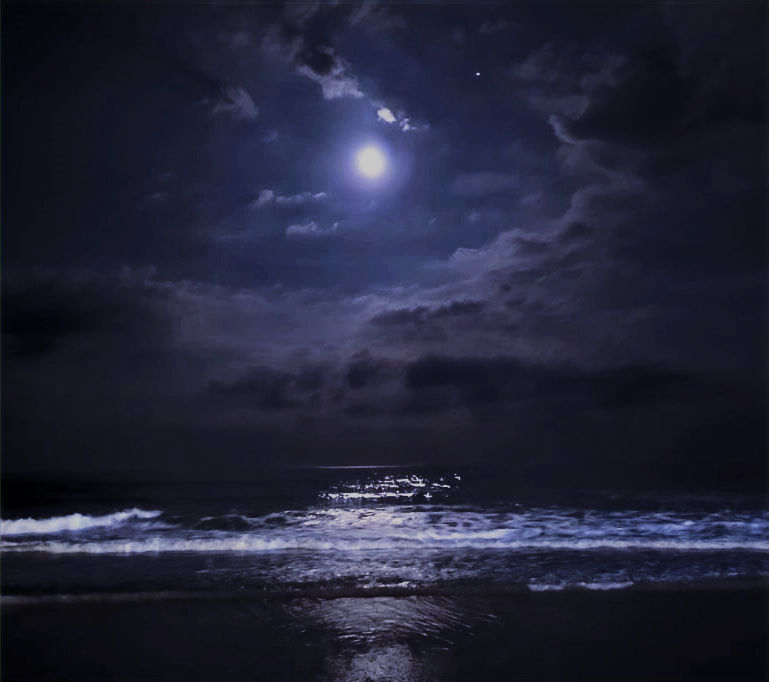
Full Moon over the Forest
The Bright Queen of Traditional Witchcraft

Black candle and mirror Spell
Calling on the power of the Dark Goddess
To be clear, the Dame is no ‘archetype’, nor would I say is she a ‘form’ of ‘The Goddess’. While Old Craft teachings recognize the duality inherent in nature expressed generally through different dynamic, complementary forces, ‘otherworld beings’ such as the Dame are seldom seen as one dimensional cultural images for general forces. Rather, in my training and experience it seems obvious that the Dame is an actual individual, sentient being .. a ‘spirit’ of a more complex order of being, perhaps of a nature that most people would struggle to comprehend. Nonetheless, she is real and alive in multiple dimensions, multiple states of existence.
I think it is fair to say that at some point in the past a link was forged between certain humans and this Lady. This was pivotal as this formed a bond which still exists today. And it is this bond that rests at the core of many Old Craft practices. The Dame is the serpent power in the land. She is the pull of the Moon that the Witch answers to. In certain older traditions her power is carried in the red cloak. These were, and still are, worn by women who represent her. We see this in documented accounts of Irish cunning women wearing red cloaks when consulted. Micheal Howard recounts that women who practiced magic in East Anglia England often wore redcaps, or cloaks[4]. This is further documented by Corinne Boyer as she recounts many folkloric sources describing the wearing of red cloaks and garments by Witches[5]. Red, power, the life force contained in blood, the power within the land, the power of fire, the serpent breath of lore, the living pulse of nature. This is the province of the Dame. She is life, from the first urge of sexual desire to the blood that flows in giving birth. Sorceress, seductress, bringer of life. It is in this regard that the red cloak is worn by the Mistress in certain secret rites. Yet she also wears the black cloak of return, death as transcendence. Through her, renewal and transformation occur. She, the Dame, is the power of the Witch.
“Quickly, Dame, bring your part . . .
A fire above and fire below,
With whip in hand to make him go.
O, now she comes!”
[1] Pennick, Nigel. Operative Witchcraft. 2012, 2019.23
[2] Wilby, Emma. “The Visions of Isobel Goodie” 2010.
Bottrell, William and Joseph Blight. “Stories and Folklore of West Cornwall” 1880.
[3] Tort, Julia Carreras Tort. “Land of the Goat: Witchcraft in the Pyrenees” 2024.
[4] Howard, Michael “East Anglian Witches and Wizards” 2017.
[5] Boyer, Corinne “Between the Witch and the Devil” 2024.